Chew, Swallow, Repeat: The Grotesque, Gorgeous, Completely Unhinged Universe of Mukbang Addiction
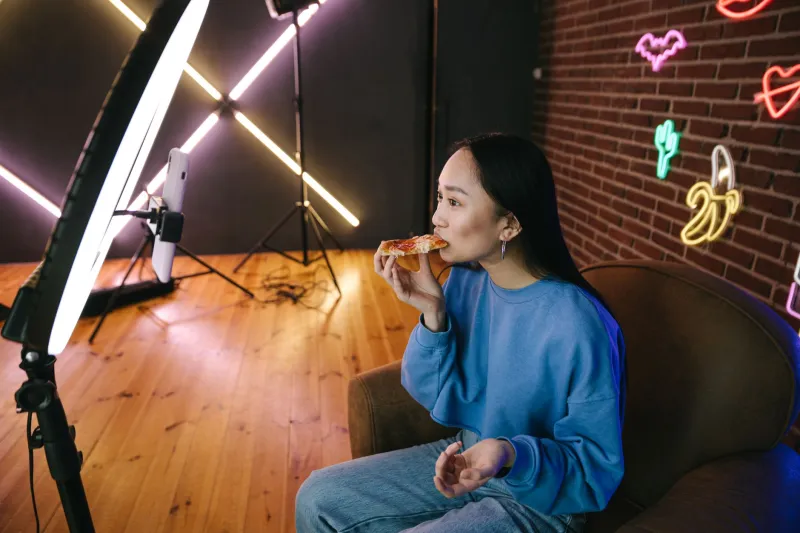
Somewhere right now, a person is sitting alone in front of a ring light, eating four pounds of crab legs with the focused intensity of a surgeon, and approximately 800,000 people are watching them do it. Nobody ordered this. Nobody saw it coming. And yet here we all are, gathered around the digital campfire of someone else's digestive journey, completely unable to look away.
Welcome to mukbang. Population: everyone, apparently.
What Even Is This, Historically Speaking
For the uninitiated — and bless you, truly, for still having that innocence — mukbang originated in South Korea around 2010. The word is a mashup of meokda (eating) and bangsong (broadcast). Early Korean creators would eat enormous meals on camera while chatting with their audiences, originally as a response to the deeply human phenomenon of not wanting to eat alone. It was companionship through a screen. Comfort food delivered via fiber optic cable.
Then the American internet got hold of it.
What started as a gentle cultural export about loneliness and community transformed, through the beautiful chaos of U.S. content culture, into something significantly more unhinged. American mukbang didn't just adopt the format — it turbocharged it, deep-fried it, dunked it in a gallon of cheese sauce, and uploaded the whole thing in 4K HDR.
Now we have creators consuming entire Thanksgiving spreads in a single sitting, people eating at McDonald's for thirty days straight on camera, and a niche subgenre where folks eat foods they are aggressively, demonstrably allergic to. For views. On purpose. This is the content landscape. Adjust accordingly.
The Uncomfortable Math of Watching Someone Eat 10,000 Calories
Here's where the ethics people show up, and honestly, fair enough. The average mukbang video involves caloric consumption that would make a dietitian's eye twitch involuntarily. Some of the genre's biggest names — names with millions of subscribers and merchandise lines and actual fan conventions — regularly film themselves eating quantities of food that exist in a genuinely uncomfortable gray zone between entertainment and spectacle.
Critics, and there are many, argue that the most extreme end of mukbang content glamorizes disordered eating, that platforms profit from content that would be flagged immediately in any other context, and that the voyeuristic pleasure audiences get from watching someone eat themselves into a visible food coma is not exactly a triumph of human civilization.
Those critics are not entirely wrong.
But here's the thing that makes mukbang genuinely fascinating rather than just easy to condemn: the psychology of why people watch it is way more complicated than "Americans love excess," which, sure, also true, but reductive.
The Loneliness Engine at the Center of Everything
Studies — actual peer-reviewed ones, not just vibes — suggest that a significant portion of mukbang viewers aren't watching because they're hungry or because they find competitive eating aesthetically beautiful. They're watching because they're lonely.
America has a loneliness crisis that predates the pandemic and got dramatically worse during it. Eating is one of the most fundamentally social acts humans perform, and for a huge chunk of the population — people who live alone, people who work weird hours, people whose social lives exist primarily online — mealtime is just a quiet room and a phone screen.
Mukbang fills that silence. The sounds of chewing, the casual conversation, the creator looking directly into the camera and asking how your day was — it mimics the sensory and social experience of sharing a meal with someone. Your brain, which is ancient and easily fooled, registers it as companionship. It releases the appropriate chemicals. You feel less alone for twenty-two minutes while someone eats an entire seafood boil.
This is either deeply sweet or deeply sad, and the correct answer is probably both simultaneously.
The Creator Economy of Competitive Consumption
On the business side, mukbang is a genuinely lucrative corner of the content economy, which tells you everything about where we are as a society and also nothing at all.
Top-tier mukbang creators pull income from multiple directions: YouTube ad revenue, sponsored content from food brands (yes, food companies pay people to eat enormous amounts of their product on camera, which is marketing genius wrapped in a fever dream), Patreon memberships, merchandise, and the increasingly elaborate parasocial economy of fan donations and super chats.
The parasocial element here is particularly wild. Mukbang audiences develop genuine emotional attachments to their preferred eaters. They know their favorite creator's go-to sauces. They celebrate when the creator tries a new restaurant. They get upset — legitimately, emotionally upset — when a creator changes their filming setup or stops doing the ASMR chewing sounds. There are Reddit threads dedicated to tracking whether a specific mukbanger seems "off" in recent videos. Concern threads. About someone they've never met. Who they watch eat.
This is not a judgment. This is just the reality of what happens when parasocial mechanics meet the most primal shared human activity.
The ASMR Overlap and the Sound People
A significant portion of mukbang content exists in dual citizenship with ASMR — the autonomous sensory meridian response genre where specific sounds trigger a pleasant tingling sensation in certain people's brains. Crunching, slurping, the specific wet percussion of someone working through a pile of fried chicken — for ASMR-receptive viewers, this is basically a spa treatment delivered through earbuds.
This is the part where your non-ASMR friends look at you with genuine concern and you have to explain that no, it's not weird, it's just neurology, and yes you know what it sounds like.
The crossover between mukbang and ASMR created a whole subgenre of content that is, depending on your brain chemistry, either the most relaxing thing on the internet or an audio experience specifically designed to drive you out of your mind. There is no middle ground. The comments sections on these videos are a monument to human diversity.
So Is It Bad, Though
The honest answer is: it depends, and also, probably ask a therapist.
For most viewers, mukbang is just a weird, harmless comfort — the digital equivalent of having the TV on for company. For a smaller segment, it might be filling a social void that deserves a more sustainable solution. For an even smaller segment, there are legitimate concerns about content that normalizes extreme consumption behaviors, and those concerns deserve more serious platform-level engagement than they've gotten.
For the creators themselves, the picture is complicated too. Some are completely fine. Some have spoken publicly about the physical and psychological toll of performing extreme eating for an audience that rewards escalation. The content treadmill doesn't care about your cholesterol.
What mukbang ultimately is, in the grand tradition of the internet, is a mirror. It reflects loneliness and community, excess and comfort, voyeurism and genuine human connection, all at the same time, in the same twenty-minute video of someone eating a bucket of ramen at midnight.
And somehow, inexplicably, it's impossible to stop watching.
The spleen knows what it wants. Apparently, it wants to watch someone eat.